
The NP613 near Rouen, 3 April 2025
The vessel has been built by Neptune Marine in The Netherlands and is of the type Eurocarrier 2712.
The contract for the delivery of this vessel comprises a first period during which it is leased on the basis of "bare boat charter" with an option to purchase.
At present, it still carries it original yard name "NP613".
The NP613 is operated by the crew that before worked on the "Brotonne", a vessel that has served the port of Rouen for about 40 years and that is destined to be replaced by the new one.
The NP613 has already shown what it's worth, with successful ploughing operation in both the upstream and downstream part of Rouen's port as well as various lifting works including the salvage of a car that has ended up in a turning circle near Hautot.
For this salvage operation, the vessel has used its large 28 tons crane of the type Heila HLRM 280-3SL that is installed on the forward deck.
Besides this crane, the NP613 is also equipped with a Heila HLRM 140-3S version on the aft deck.
HAROPA PORT has the intention to make the new vessel also suitable for water injection dredging by fitting out a plough blade with two submersible pumps and a series of nozzles.
Furthermore, it is being considered to acquire a second water injection dredging vessel in the near future, this one is scheduled to be mostly deployed in the Le Havre area.
Dredging near Honfleur
For maintenance dredging, HAROPA PORT has three hopper dredgers at its disposal, which, although officially owned by the French state organisation GIE Dragages Ports, are fully managed and operated by HAROPA PORT.The smallest one is the trailing suction / grab hopper dredger Gambe d'Amfard with a hopper capacity of 780 m3.
The Gambe d'Amfard is mostly deployed to dredge the harbour basins of Le Havre.
The 1,800 m3 trailing suction hopper dredger (TSHD) Jean Ango works most often in the upstream part of the river Seine and near the quays of Rouen.

The Daniel Laval near Honfleur, 2 April 2025
The largest hopper dredger is the 5,000 m3 Daniel Laval, which almost continuously operates in the downstream part of the Seine and the maritime access channel of Le Havre.
Depending on the circumstances, at occasions the deployment of a dredger may shift to other areas.
Although the dredging need per location is reasonably predictable, the Seine is also known to have its caprices and sometimes the sedimentation rate at a certain spot is surprisingly high.
Such was the case recently in the fairway and near the quays at Honfleur.
The beginning of 2025 saw an exceptionally high accumulation of sediment here.
Since Honfleur is an important port of call for cruise ships and the first visits of the cruise season scheduled for April, it was decided to have both the Daniel Laval and the Jean Ango taking up this dredging tasks.
Valorisation of dredged material
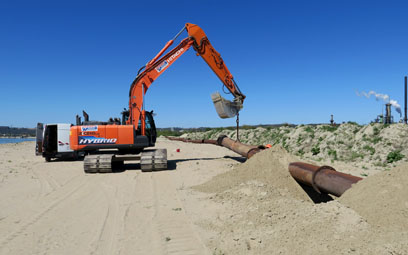
Transit facility at Port Jérôme
HAROPA PORT aims at reusing dredging material as much as possible.
Whenever suitable for use in construction projects, like sand, the material is pumped ashore in so-called transit facilities.
Here the material can be temporarily stocked to be either sold to construction companies or used by HAROPA PORT in one of its own projects.
There are several of these facilities along the river Seine, all strategically located in view of both the source of the material as well as the potential of reuse.
The port organisation has set up a dedicated study known as SEDINNOVE to combine the input of the sediment characteristics, physical and environmental, with the needs and demand in specific economic zones.
One such zone is Port Jérôme where important economic developments take place and where the Jean Ango is scheduled to bring sand once the dredging campaign near Honfleur has been completed.
Sediment that is not or much less suitable for the construction industry, is used for landscaping, mostly along the upstream part of the river Seine.
Here are located many gravel pits that, after being depleted, need to be filled to restore the landscape.
Dredged sediment is very suitable for this purpose.
In some cases, after having been filled, an area will be used for agricultural use, but in other cases it is destined to become a nature area.
Such is the case in Anneville-Ambourville where a gravel pit that is exploited by the aggregates company CEMEX, is now being prepared by HAROPA PORT to receive sediment over the next few years, after which nature will be able to develop.