
Mr. Jan Huijbers and Mr. Tim Versnel holding speeches.
The realisation of this park is an prime example of the many projects that have been carried out in old city harbours across Europe.
In fact, over the past decades in several European cities, port activities have been shifted from urban areas to new and more remote locations, often closer to the maritime access.
Main drivers for this shift were both the increase in shipping traffic as a whole, as well as the increase in size of the ships.
This development required more deep draught berthing capacity, something the older harbour basins, often more than a century old and located near the city centre, couldn't offer.
What also played a role is the fact that the handling of cargo became more and more mechanised and automated, significantly reducing the need for manual labour and as such being close to populated areas with a high potential of labour force was no longer a necessity.
Furthermore it also allowed for putting an end to nuisance related to port activities, such as dust, noise and smell in the city centres.
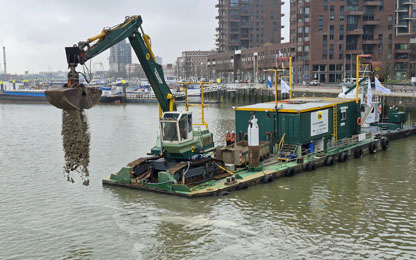
The Herik 69 places the first m3's of sand.
In Rotterdam for example, most important port activities are now taking place in the Europort area, developed between 1958 and 1964, and the first and second Maasvlakte, which were reclaimed in the 1970s and the beginning of this century respectively.
While some small scale activities have remained, mainly for inland vessels, the old city harbours being abandoned by large scale port activities gave room for new and more city friendly redevelopment.
In Rotterdam, already several years ago the city harbours on the northern side of the river Nieuwe Maas have witnessed an impressive transformation.
At this moment it is the turn to the harbours Rijnhaven and Maashaven on the southern side.
Redevelopment of the Rijnhaven is the most advanced, since 2022 important sand replenishments have been carried out in several stages to fill almost a third of the harbour.
After having had the time for proper settlement of the sand, work will start to shape the area according to its final design.
In view of the presence of several vulnerable infrastructure objects, such as old quay walls, a nearby metro line and an important drainage pipe of the local water board, the filling operation and accompanying works need to be carried with the most delicacy.
Maquette showing the final shape of the park.
At the Maashaven, the filling stage of the eastern part of the harbour has now started, as has been symbolised by the kick-off ceremony.
The ceremony started with speeches of City of Rotterdam's alderman Mr. Tim Versnel and Mr. Jan Huijbers, director of Van den Herik.
Marine and dredging contractor Van den Herik is the company that has been awarded the contract for this iconic project by the City of Rotterdam.
The ceremony also comprised the unveiling of an information board and the placement of the first m3's of sand by Van den Herik's dredging pontoon Herik 69.
It is scheduled that these works will take until 2028.
By that time, some 400,000 m3 of sand and some 50,000 kg of rock will have been placed.
The project also comprises the construction of 350 meter of sheet pile wall.
Once this stage of the project has been completed, further landscaping can take place which is scheduled to take another two years.
By that time, the Nelson Mandelapark, as it will be called, will provide ample recreational space including sports fields for various leisure activities.
The park will also comprise a tidal area where plants and animals that thrive in brackish water can flourish.